How to Tell if Your Nervous System is Stuck in Survival Mode

You’re Not Broken: A Gentle Introduction to Nervous System Stress
Do you feel it too…
The quiet unease of not knowing what’s coming next?
The constant stream of information pressing in — until procrastination, fatigue, or shutdown take over?
A body craving rest, held awake by a mind that won’t slow down?
I thought it was just me — until I learned 70 to 80% of adults experience stress intense enough to create physical symptoms. *
It’s true, friend. You’re not alone in this.
Life has always moved through seasons of light and shade. And in times that feel especially demanding, uncertain, or relentless, it makes sense that the nervous system responds the way it does.
Understanding what’s happening in the body isn’t about diagnosing yourself —
It's often the first gentle step toward relief.
What “Survival Mode” Means in the Nervous System (Without the Jargon)
Things around us are constantly happening that trigger stress hormones — some minor, some major. In small doses, the body’s natural stress-response system is designed remarkably well. But what happens when those doses become disproportionately out of balance?
When the nervous system isn’t overwhelmed, it knows how to move through stress and return to balance:
Threat sensed → Protection activated (fight/flight) → Safety detected → Regulation restored.
Now let’s turn up the dial. Anxiety: heightened. More threats are appearing from every angle —
Home
Work
Health
Economy
Environmental
Lingering uncertainty
Etc.
You’re reaching that can’t-catch-a-break feeling.
The body shifts from regulating small doses of survival responses to managing heavier, more constant ones — cue transition to Survival Mode:
Threat sensed → Protection activated → Safety remains uncertain → Protection continues
This doesn’t mean the body is malfunctioning — it means it hasn’t yet received enough safety signals to stand down. In fact, research shows that under prolonged stress, the brain and body physically adjust to maintain a high-alert state, keeping stress hormones elevated even after immediate threats have passed. *
Research also shows that our body’s stress-response system is dynamic and finely tuned to respond to everyday stressors. When these rhythms are disrupted — as happens with chronic stress — the nervous system can stay in alert for longer than needed. *
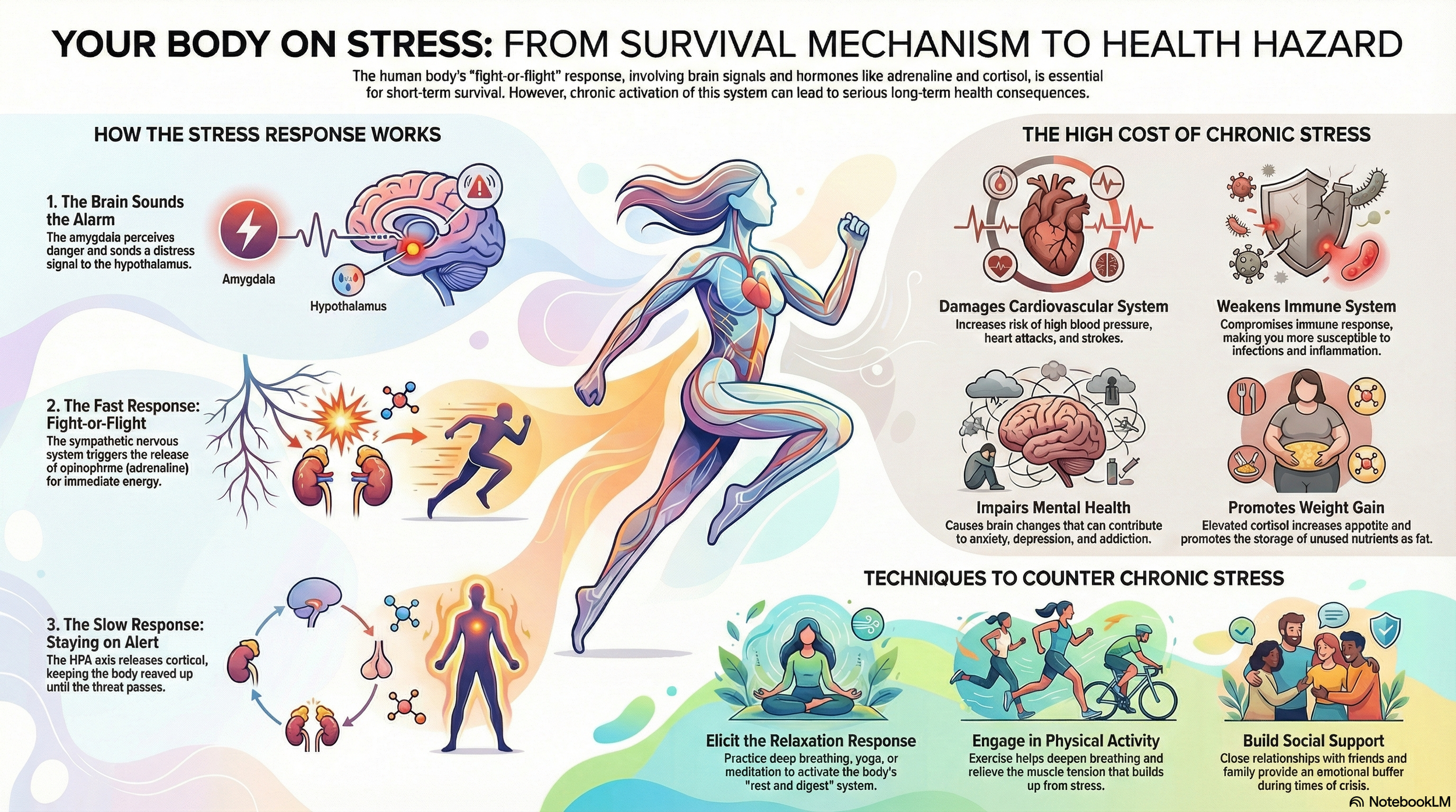
Even when the immediate threat has passed, your body may still feel keyed up, on edge, or drained. This is your nervous system staying in protection mode — it hasn’t yet fully received enough safety cues to relax. In this heightened state, you might notice your body responding in one of several natural ways, sometimes without you even realizing it:
Fight — Feeling irritable, defensive, or ready to confront what’s happening
Flight — Wanting to escape, avoid, or disconnect from the situation
Freeze — Feeling stuck, numb, or unable to act
Fawn — Trying to appease, please, or keep others happy to stay safe
These responses aren’t “wrong” or signs that something is broken — they’re your nervous system’s clever, protective strategies.
And while these responses are protective, in today’s world — with constant information, unpredictability, and chronic stressors — many of us spend more time in this high-alert state than our nervous systems were designed to handle.
Why So Many Nervous Systems Are Stuck in Survival Mode Right Now
What many of us are experiencing isn’t burnout or failure — it’s the cumulative weight of living in a world that rarely pauses.
From every direction, we’re expected to keep going, regardless of what’s happening in our lives.
The world feels like it’s burning — we’re still expected to clock in.
We’re exhausted from work — we’re still expected to show up, cook dinner, hold it all together.
Even when we’re doing our best, there’s a quiet pressure to do more, optimize further, push harder.
Common Signs Your Nervous System Is in Survival Mode
So those feelings that won’t seem to leave you alone?
They may not be random — and they’re not a personal failure.
-
You open your laptop or walk in a room and forget why.
Brain fog is so thick you’re losing words mid-sentence or rereading the same paragraph three times without absorbing it.Simple decisions feel exhausting.
What to eat, what to answer, what to start first — everything feels oddly heavy, so you avoid deciding at all.Your thoughts won’t slow down, but nothing feels productive.
Your mind is loud, scattered, and somehow still stuck.
-
You snap at someone who didn’t deserve it — then immediately feel guilty.
You don’t want to react this way, but your patience feels paper-thin and hard to recover.You feel numb one moment, overwhelmed the next.
Small things spill you over, while big things leave you strangely disconnected.You’re more irritable or defensive than usual, and you can’t explain why.
It feels like everything — and everyone — is just too much.
-
Your shoulders live near your ears.
Another tension headache. A tight jaw. A body that won’t fully relax, even when you’re resting.You’re exhausted… even after sleeping.
You wake up already depleted, like your internal battery never really recharged.Your breath is shallow, your stomach unsettled, your body uneasy.
Nothing dramatic — just a constant low-grade discomfort that follows you through the day.
-
You scroll longer than you mean to.
Not because you’re interested — but because stillness feels uncomfortable.You swing between overworking and avoiding everything.
Productivity becomes a shield, procrastination becomes protection.You pull back from people you care about.
Not because you don’t love them — but because you don’t have the energy to explain how you’re feeling.
You don’t need to recognize yourself in all of these for this to be true.
Even a few are enough to tell us something important is asking for care.
What Survival Mode Is Not — And Why Self-Blame Makes It Worse
It’s important to remember:
These are symptoms of something greater — not character traits, and not who you’ve become.
Survival Mode is NOT:
Laziness
A lack of discipline
A motivation problem
A character flaw
Poor work ethic
Failure
Why does this matter?
Because when we let these labels tell our story, the self-judgment adds weight to an already heavy system — pushing whatever energy we have left even further underground.
Think of it as separating the experience from the self.
Notice the difference between these two sentences:
“I know I have x, y, and z to do — I’m just feeling lazy.”
vs.
“It’s been a long week. x, y, and z will still be there after some rest.”
The difference is subtle — but the impact isn’t.
One adds judgment to exhaustion.
The other acknowledges stress without turning it into a personal failing.
That separation matters.
Because when we stop blaming ourselves, we create the conditions the body actually needs to recover — and eventually, to re-engage with what matters.
What Actually Helps When You’re in Survival Mode (Without Fixing Yourself)
Since so many of us do not offer ourselves validation and grace, I want to offer it to you here.
First things first, it’s ok.
It’s ok to:
Not answer that Slack message outside of working hours
Forget something and have to turn around
Cancel plans because your body says “not today”
Feel the weight of every task on your to-do list
Feel overstimulated by noise — or even the sound of your name being called
Simply need a nap
Let’s start with that.
When we name what’s actually happening, we can take self-blame off the table.
And while this shift can take practice, it’s worth learning how to move from “something is wrong with me” to “my body has taken all it can handle right now — it’s asking for rest.”
Restoring looks different for everyone whether it’s literal rest, unplugging digitally, gentle movement, present-moment exercises, etc.
The goal isn’t intensity.
It’s consistency.
Not doing more — but doing less, more often, in ways that signal safety to your nervous system.
You don’t have to perform your healing.
There’s no routine. No morning ritual. No miracle fix waiting on the other side.
Just small moments of regulation that remind your body it doesn’t have to stay on high alert.
And there’s a reason this works — even when it feels small.
A Note on Healing Timelines: Regulation Isn’t Linear
Healing doesn’t move in straight lines.
Some days will feel lighter.
Other days, it may feel like you’re right back where you started.
That doesn’t mean you’re doing it wrong.
In The Body Keeps the Score, Dr. Bessel van der Kolk explains that the body learns from repeated stress — not just major events — and stores those patterns as protection.
Which means what you’re experiencing isn’t weakness.
It’s a system doing exactly what it was designed to do.
There’s no version of healing that requires you to do it alone either.
Support is allowed.
Rest is allowed.
Taking longer than you expected is allowed.
A Gentle Reminder for When You Need It Most
If this resonated, you don’t need to do anything with it right now.
Let it sit.
Come back to it when you need the reminder.
** Some links on this site are affiliate links, which means I may earn a small commission if you choose to purchase — at no extra cost to you. I only recommend products and resources I’ve personally vetted and genuinely believe in, partnering with brands that align with my values and yours. **